
‘Project Osprey:’ How Nvidia Seeded CoreWeave’s Rise
Nvidia invested in CoreWeave, funneled scarce high-end graphics processing units to the company and agreed to rent back its chips from CoreWeave.
In early 2023, Nvidia was seeing near-endless demand for its artificial intelligence chips. Cloud computing giants such as Amazon Web Services, Microsoft Azure and Google Cloud were increasing their orders, sending Nvidia’s revenue to new heights. Developers were scrambling to access the chips, which were hard to come by.
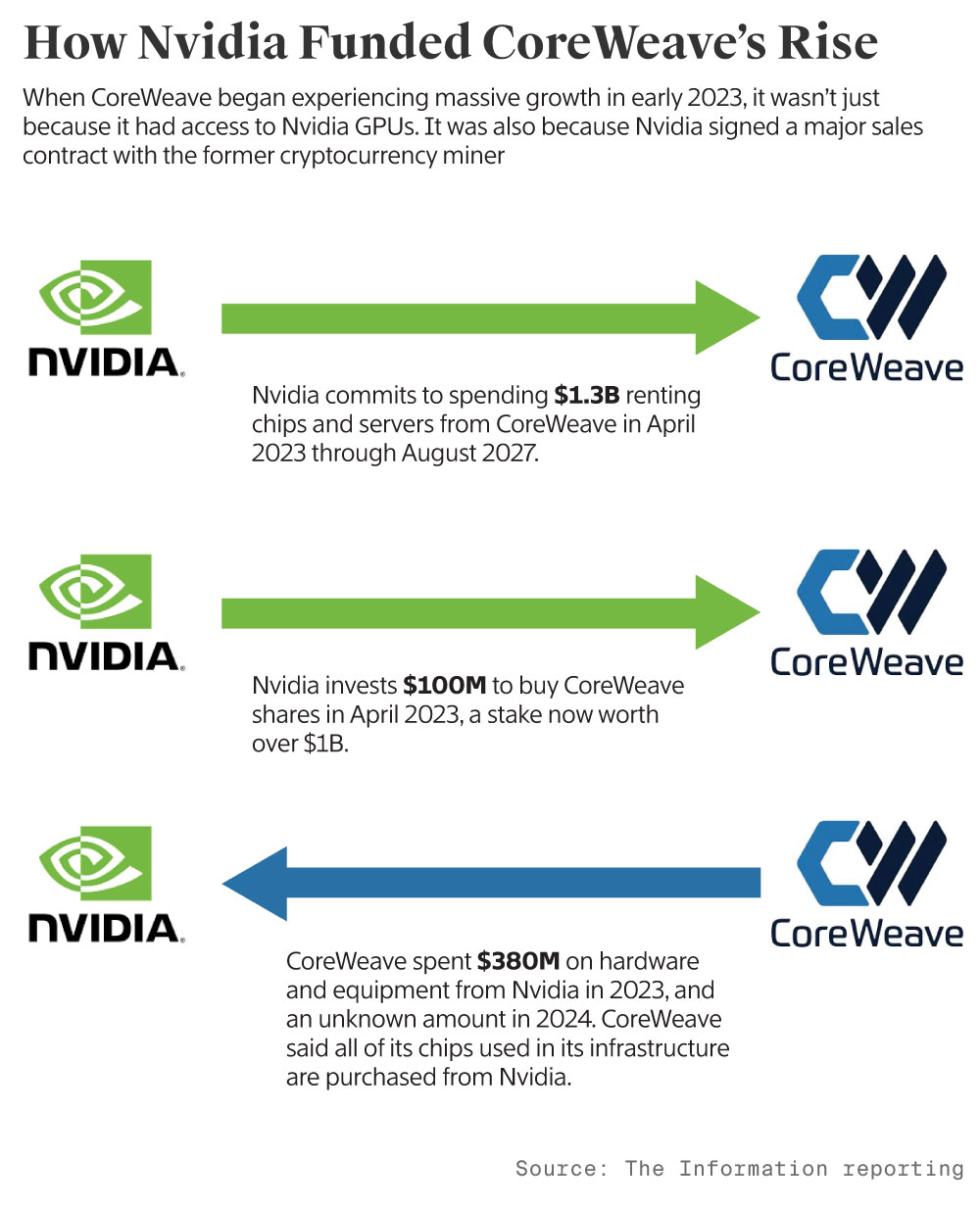
Then Nvidia made a curious move: It agreed to spend $1.3 billion over four years to rent its own chips from CoreWeave, an upstart cloud computing firm trying to take on the giants. The deal, which CoreWeave dubbed “Project Osprey,” made Nvidia its second-largest customer last year after Microsoft, documents show, a detail not disclosed in CoreWeave’s filing last week for an initial public offering.
The Takeaway
- CoreWeave’s ties to Nvidia run deeper than previously thought
- Nvidia was CoreWeave’s second-largest customer last year
- Nvidia’s relationship with CoreWeave is key to its ambitions to grow its cloud revenue
Powered by Deep Research
The deal shows how crucial Nvidia’s support has been to CoreWeave. The chip giant invested $100 million in the startup in early 2023. It funneled hundreds of thousands of high-end graphics processing units to CoreWeave. And it agreed to rent back its chips from CoreWeave through August 2027. Revenue from the deal represented 15% of CoreWeave’s sales last year.
CoreWeave expects to go public later this month at a valuation of more than $30 billion. If that’s the case, Nvidia’s $100 million equity investment two years ago would be worth more than $1 billion.
The circular financial arrangements are the latest example of how the money piling into AI is often coming in and out of the same places. SoftBank, in talks to become one of OpenAI’s largest benefactors, agreed to pay that company $3 billion each year to use its AI software for other startups, The Information previously reported. Microsoft has invested more than $13 billion in OpenAI, which then gives Microsoft a share of its revenue and pays the software giant billions annually for cloud services. Amazon and Google have struck similar deals with AI model company Anthropic.
Prospective investors have been grappling with how long they can count on CoreWeave to sustain such big customers. Contracts with Microsoft and Nvidia, which together made up more than three-quarters of the company’s sales last year, expire between 2027 and 2029.
CoreWeave, meanwhile, has fueled its expansion with $8 billion in debt and $15 billion of long-term leases for data centers and office buildings, making it essential to attract new customers to supplement its original deals. The unusual combination—a high concentration of customers, combined with significant growth and debt—has raised eyebrows among investors weighing how to value the company.
“I’ve never seen anything that has grown so fast but could have a real disruption in how it makes money pretty easily,” said CJ Gustafson, a former tech executive who now publishes a finance newsletter, Mostly Metrics. But, he added, “a lot of revenue cures a lot of sins.”
Nvidia declined to comment and CoreWeave didn’t have a comment.
On Monday, CoreWeave announced its own $11.9 billion, five-year deal with OpenAI under which the ChatGPT maker will buy cloud services from CoreWeave. The deal would allow CoreWeave to book about $2 billion annually in additional revenue over that period, reducing some of its dependency on Nvidia and Microsoft.
It’s unclear if OpenAI plans to buy cloud services from CoreWeave beyond that contract. In a press release, OpenAI said the deal would complement other cloud services it buys from Microsoft and Oracle, as well as the separate, SoftBank-backed data center project, Stargate.
OpenAI has told its own investors it expects Stargate to support three-quarters of the computing power it will need to run and develop its AI models by 2030, The Information previously reported.
Albatross and Osprey
It’s unclear exactly why Nvidia wanted to rent its own chips, but the company had several reasons to be interested in CoreWeave. Nvidia rents servers from cloud providers—including from CoreWeave—for its internal research and development teams.
Nvidia also rents servers from cloud providers for its DGX cloud computing service, which re-rents the servers to Nvidia cloud computing customers. CoreWeave has told investors it supports DGX, The Information previously reported.
In addition, Nvidia executives were concerned two years ago that it was becoming too reliant on large cloud providers such as AWS and Microsoft, The Information previously reported. Those companies are developing their own AI chips in an effort to lessen their reliance on Nvidia’s. They have also been using Nvidia’s chips for their internal AI teams, limiting the availability of the chips for developers.
For CoreWeave, the Nvidia deal helped it build its cloud computing business at exactly the right moment. In 2021, the company made nearly all its revenue from mining ethereum. It hadn’t raised money from traditional tech investors or venture capitalists, but instead turned to lenders and a smattering of investors like wealthy families and cryptocurrency entrepreneurs.
It discontinued the crypto mining business in September 2022, as the price of ethereum fell, to instead use its data center capacity for visual effects rendering and AI. Then, in late 2022, ChatGPT launched.
The commitments from Nvidia, in addition to more than $4 billion in orders from Microsoft at the time, helped CoreWeave borrow $2.4 billion from other investors including Blackstone a few months later, allowing it to build out more data centers.
CoreWeave called the Microsoft deal “Project Albatross” and the Nvidia deal “Project Osprey,” intending to keep the customer names secret from outsiders. Microsoft became the larger, more publicly known customer, as it struck additional deals with CoreWeave to meet data center capacity needs as OpenAI’s ChatGPT and other AI tools grew in popularity. Unlike Nvidia, Microsoft didn’t become a CoreWeave shareholder.
CoreWeave, in turn, purchased $380 million in chips and other hardware from Nvidia in 2023, documents shared with investors last year show. That spending total likely grew significantly last year. The company wrote in the prospectus that it purchases all of its chips from Nvidia, without specifying the total.
CoreWeave told investors last year it expected to have about 240,000 Nvidia chips online in its data centers by the end of 2024—mostly H100s, the version of Nvidia’s chip that has been on the market since the early days of the AI boom. It forecast that it would more than double that number by the end of this year once it amasses more advanced Nvidia chips, such as the H200s, as well as more than 100,000 of Nvidia’s new Blackwell chips.
The money Nvidia paid CoreWeave last year—in excess of $25 million a month, according to sales projections—was far more than what some of the other customers CoreWeave displayed in its IPO prospectus were spending. For example, CoreWeave cited model fine-tuning startup Replicate and quant trading firm Jane Street, which expected to spend hundreds of thousands of dollars a month with CoreWeave last year, internal materials show. (Jane Street is also a small investor in CoreWeave.)
CoreWeave, meanwhile, has touted Nvidia’s support. In a presentation to investors last year, the startup included a slide with a picture of Nvidia CEO Jensen Huang alongside a statement Huang made on an earnings call talking up a “whole new crop” of cloud service providers.
The slide highlighted the end of the quotation: “One of the famous ones is CoreWeave and they’re doing incredibly well.”